Does rising CPF wage ceiling put more cash in your pocket?
How the rising CPF wage ceiling impacts your monthly cash-on-hand after your mortgage payment.
· 4 min read
How do CPF contributions work? The standard answer is the employee contributes 20% of their income, and the employer adds 17%.
While this may be true for many Singapore citizens and permanent residents, this is an oversimplification in general. As of 2025, there are two wage ceilings, which are base amounts actually used to calculate the final CPF contributions. One of the ceilings is the so-called ordinary wage ceiling, while the other is the additional/annual wage ceiling. We will focus on the ordinary wage ceiling (and will refer to it simply as wage ceiling for the rest of this article) since it’s the most relevant for your mortgage.
As of 2025, the wage ceiling is at $7400, and it will be raised to $8000 in 2026. It does not stop here: the wage ceiling has been steadily rising for decades to track median income, and will rise again in the not-so-distant future. To illustrate with data from the government:
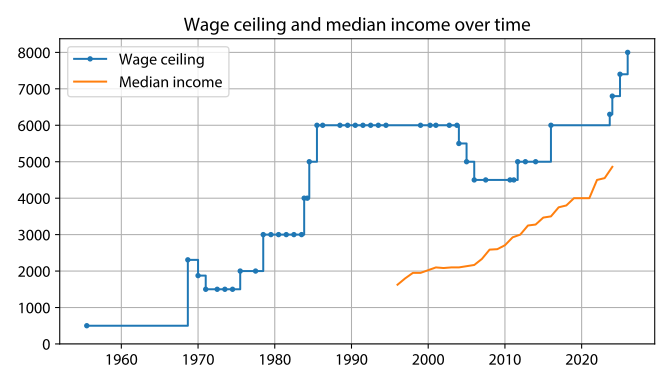
Very crudely, the CAGR of the wage ceiling from 1955 to 2026 is approximately 4% per year. Coincidentally, the CAGR of median income before CPF between 1996 and 2024 is also approximately 4% per year.
Many homeowners in Singapore use the CPF OA (ordinary account) to fund part of their mortgage payments. Since the mortgage is one of the biggest expenses for most people, it makes sense to ask the question: how does rising wage ceiling affect my income after mortgage payment?
The impact on your cash-on-hand #
For this article, “net income” refers to your monthly cash-on-hand after the mandatory CPF deduction and the monthly mortgage payment. It’s important to understand the impact on net income because it may affect how much you can invest with your cash flows.
Let \(M\) be the monthly mortgage payment, \(I\) the income, \(C\) the current wage ceiling, and \(C^\prime\) the new wage ceiling, with \(C < C^\prime\). If \(I \le C\) and \(I \le C^\prime\), then the change in wage ceiling should not affect your net income. This is because the total CPF contribution amount remains exactly the same.
Instead, consider the case where \(C < I\) and \(C^\prime < I\). Let \(m_w\) be the employee’s CPF contribution rate (based on the minimum of wage ceiling and income) and \(m_e\) be the employer’s CPF contribution rate. Let \(a\) be the OA allocation rate, which is the fraction of the total CPF contribution allocated towards the OA. The remaining portion of mortgage payment after paying with the CPF OA using the current wage ceiling \(C\) is given by \[ \max(M - \left(m_w + m_e\right) a C, 0). \] This can be 0, which occurs if your CPF OA covers the entirety of the mortgage payment. If this quantity remains 0 with the new wage ceiling \(C^\prime\), then the change of wage ceiling definitely reduces your net income. The change in net income in this case is given by \[ \boxed{\Delta P = -m_w \left(C^\prime - C\right)}. \]
What if the remaining portion is greater than 0. Then the net income \(P\) is \[ P = I - m_w C - \left( M - \left(m_w + m_e\right) a C \right). \] The net income after the change in wage ceiling, \(P^\prime\), is similar except we substitute \(C\) with \(C^\prime\). It can be shown that the change in net income is \[ \boxed{\Delta P = P^\prime - P = \left( \left(m_w + m_e\right) a - m_w \right) \left(C^\prime - C\right)}. \]
Observe that with the assumption of \(C < C^\prime\), the sign of \(\Delta P\) depends solely on the sign of the factor \[ d = \left(m_w + m_e\right) a - m_w. \] Observe also that \(0 \le d\) if and only if \[ \boxed{\frac{m_w}{m_w + m_e} \le a}. \] In other words, your net income rises when the OA allocation rate exceeds the employee share of the total CPF contributions. It’s a sligthly unintuitive relationship, but mathematically clean!
Example #
As a concrete example, in 2025, someone at an age of 30 has \(m_w = 0.20\), \(m_e = 0.17\), and \(a = 0.6217\). We may compute \[ \frac{m_w}{m_w + m_e} = \frac{0.20}{0.20 + 0.17} \approx 0.5405 \le 0.6217 = a. \] The increase in net income is minute though. For example, between 2025 and 2026 the wage ceiling will be increased by $600. Substituting the numbers, we obtain \(\Delta P \approx \$18.02\).
Someone at a different age will have different numbers, and could potentially have \(\Delta P < 0\), though by a minute amount as well. For example, someone at the age of 45 has \(a = 0.5136 < 0.5405\) hence \(\Delta P < 0\). For a wage ceiling increase of $600, this translates to a mere \(\Delta P = -5.9808\).
It’s a good news that the rising wage ceiling has little impact on your cash-on-hand!